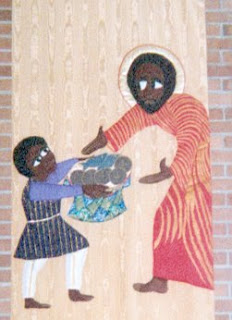
It's an odd way to begin a new year. (So-called liturgical churches follow a calendar that ends with the last Sunday in November and begins a New Year with the season of Advent on the first Sunday of December.) Rather than hearing songs of auld lang sine; or toasting with champagne, the church has us hear another version of Jesus' last will and testament. Like Matthew's parable of the sheep and the goats (Matt 25), Mark's Jesus speaks about what we've come to call, erroneously, the second coming. If Matthew's version of Jesus’ last words challenges his followers with the image of judgment, Luke's version (Luke 21:25-36 is a call to watch for signs of the end.
Speeches about the end of history often use the language of apocalyptic. Apocalypse means revelation and apocalyptic has been widely used to speak of the end of time and events leading up to it in colorful, sometimes coded, imagery. Old Testament images, such as those drawn from Isaiah 13, in Jesus' words about a darkened sun and dimmed moon, and falling stars, are very common. In the Book of Revelation we have elaborate descriptions of the end times. In Luke, Jesus is more restrained, sweetening the revelation with the parable of the fig tree.
Here Jesus is the focus, describing himself with apocalyptic imagery from Daniel, chapter 7, about a "son of man" receiving authority to rule after centuries of "animals," who symbolize foreign political powers. It's Jesus who subverted the powers which destroy people, as we heard Mark tell us in his account of Jesus ministry, throughout this past year. As we heard and saw that ministry unfold, we came to recognize that it's Jesus and his rule which will outlast all such oppressors.
The folks to whom Mark was writing were very familiar with that sort of oppression. In earlier verses of this chapter Mark refers to the horrendous consequences of the Jewish revolt in the years 66-70, which ended with the Romans starving out Jerusalem before breaking through the walls and destroying the Temple. With this horror fresh in their memory, Mark's first hearers would have been able to relate to warnings about false messiah's and false prophets. They were in a good position to read the signs of the times. In Mark's view their times must be the last times.
It's very hard for most of us to walk in those shoes, whether the cobbler is early-Mark or later-Luke. What does it mean to feel that things are so bad the only hope is a quick end to the world? The poetry of pain and despair, the fantasies of escape and resolution, challenge us to silence, to listening.
What do people in such a situation need to hear from their God? What would a faithful and loving God say to people in such despair?
Like those early church communities, we're living beyond what was for so many, the real and final end of days. Like Luke's community of faith, we, too, have some time to gather together and to hear. And in that hearing we need to listen to the clear and convincing word of Jesus that, energy spent trying to guess at the end, or chart the details of the final plot, is irrational. Jesus says, "But about that day or hour no one knows, neither angels in heaven, nor the Son, but only the Father."
The word from Jesus, the word which God's struggling people need to hear; the word from our faithful and loving God is this, "Beware, keep alert..." This isn't a mandate to focus on predicting the future in a kind of "I know something you don't know" game, where me and my group engage our powers of prediction or claims to privileged revelation, and get a religious buzz out of applying biblical prophecy and believing we know - like those folks who put a sticker on their bumper that says, "In case of rapture this car will become unoccupied."
The Word from our faithful and loving God, the Word we need to hear, and the Word God speaks in Jesus says, "Stand up; Raise your heads, Live! Live in the authority by which you can trust. Trust that the Lord is our Father, we are the clay, the Lord is the potter, and we are all the work of God's hands."
That's what we know. That's the bold claim on which it is our privilege to stand. We to whom God has given the time and the space to see, and to reflect on, and to speak against what's going on in the oppression of folks whose suffering makes it impossible to speak for themselves, have a crucial role for change in the world. "Be alert!"
Watchful living has less to do with speculation about the end of the world and more to do with carrying on in our trust. And carrying on, as Jesus tells it, makes the date of the end irrelevant. Readiness has as much to do with being ready for living as it has to do with being ready for its ending.
In every age, folks get misdirected here. When a brother working in the fields along side St. Francis asked what he'd do if he knew the end of the world was coming, Francis is alleged to have said, "Well, I'd really like to finish hoeing this row." When, one autumn afternoon, Luther was asked what he'd do if he knew that the end of the world was coming next Spring Luther is said to have replied, "I think I'd still like to plant a little fruit tree."
You see, we don't have to fear the end because we've already been through the end. In every new moment, the world as we know it has come to an end. And by that end, a new beginning has dawned; a beginning wherein God is still God - we the clay, God the potter.
Every day we live in and for that time when God will tear open the heavens and come down. Advent isn't a season of waiting; it's a lifetime of waiting. Watching for what we've already lived through to occur again. God tore open the heavens and came down:
• at creation
• to stay Abraham's hand and spare Isaac's life
• to tell Pharaoh, ten times, "Let my people go!"
• in a manger
• to unseal the tomb
• to fill the disciples' hearts with fire on Pentecost day.
In Luke's day, to watch was to live the life of a disciple, with an eye to what was happening in the world. Living as disciples of Jesus, in our day, means nothing less.
I wish 2000 years of failed predictions made us more sober. But, too often, we've given in to the fear and withdrawn from the world. Too often we've chosen not to speak against the cries of pain we hear all around us. Too often, we've narrowed our focus, watching only the private footsteps of our own moral goodness. It's an attractive religion that lulls us to sleep easy. It's a harmless religion that teaches us to live stress free. But that kind of religion doesn't have much to do with the kind of engaged alertness Jesus speaks about; the alertness by which we recognize new leaves, and take up the work given to us until the Master returns.
December 1st, marks the 51st anniversary of Rosa Parks' refusal to give up her seat on a bus to a white man. Rosa Parks was tired. At the end of her long day at work as a seamstress, no one would have faulted her for movin' back. Was God indifferent to her oppression? Was God absent? Was God no longer at work for those who were waiting?
Somehow Miss Rosa came awake. Somehow she knew that the work needin' done had been entrusted to slaves until the master's return. So she sat, and the world she'd known so well, came to an end. This secretary to the NAACP was arrested and sat in a squad car. This woman who'd been denied voter registration sat in court and was convicted. This Sunday school teacher sat in jail. And for all of us, on the day that Rosa Parks sat, God had the last word, the world as we knew it ended, and a new world dawned.
Jesus' last words become our first words in the Church's New Year: a call to be awake to what's happening in our world and to be looking for and in tune with the One who comes, whether for the final time - as in traditional expectations about the Second Advent - or for any time, for now.
Now. Can we make the prayer of Isaiah our own? What would it feel like if God tore open the heavens and came down? Can we trust that we've already been through the end with this God? Can we yield, again, to the power of this God who has, with the gift of every new moment, ended the world as we know it?
We:
• leave home, and the world as we know it ends
• get married, and the world as we know it ends
• receive a diagnosis, and the world as we know it ends
• lose a parent, and the world as we know it ends
• divorce, and the world as we know it ends
• go to sleep at night and the world as we know it ends.
In such situations what do we need to hear from God? What would a faithful and loving God say to us? Can we trust that we've already been through the end with this God? This is what we mean when we make our Advent prayer: Come, Lord Jesus!
When Jesus comes into our hearts, he brings along all the needy of the world. To whom else would the God who works for those who wait for God bring those lost and least but to we whom God has called into the fellowship of Jesus Christ?
We who know so well this lesson, that some days God does seem indifferent and absent, cry out in our distress and in our longing, full of trust that Christ holds the future for ourselves and the world. We keep awake, not for the birth of an unknown babe whose life has yet to unfold, but for the return of the one who knows us and is known by us; for the One whose presence we feel and hear and touch, in Word and Sacrament, whenever the world as we know it ends and a new world dawns. We keep watch for the teller of parables, the banquet host, and the friend of sinners. We are waiting for the crucified and risen Lord, in whom we both know the sleep of heavenly peace, and the resurrection waking.
Not only don't we know the day or the hour, we also don't know whether or not God will ask us to stand up or sit down! Until we hear a clearer message from our faithful and loving God, Beware, as we hoe one more row against injustice. Keep alert, as we plant another fruit tree for the springtime of freedom. You see, the end, again, is the beginning, again!
Showing posts with label end-times. Show all posts
Showing posts with label end-times. Show all posts
Wednesday, November 29, 2006

Monday, November 20, 2006
Embracing Terror
Someone asked me to stop by her house Friday to check out an electrical problem. I should say it was a simple electrical problem. In about three minutes I was only able to verify what she already knew, then give her the name of an electrician I know.
As I made my way toward the door, she asked me to look at a broken drawer in the kitchen. Next, she wanted me to see a problem with a towel rack in the bathroom. After that, it was the non-starting vacuum cleaner. Finally, as I headed again for the door, for sure this time, she blocked my way and began sobbing.
She needs to spend two weeks in the hospital, but doesn’t know where to send her children. Her uncle is being discharged from a nursing home but has nowhere to live. It was obvious the woman is overcome with dread. She’s terrified.
The dictionary’s definition of terror is “an overwhelming fear.” It’s a noun, not a verb.
I’m not sure how you’d launch and sustain a war on terror. For that matter, I have no idea how one would launch and sustain a war drugs or a war on poverty – much less with those wars. I also don’t understand how greed seems to drive contestants on the TV show, “Fear Factor,” strengthens them to do what they do. What I do know is the two most common responses to overwhelming fear, among humans and even in the lowest forms of animal life, are fight or flight.
Brain research shows that those instincts reside in the most primitive part of the human brain. Located just above the part of our brain that keeps us breathing, this unsophisticated body part is called the reptilian brain. It requires neither thinking nor decision-making (higher brain functions) for the reptilian brain to become engaged and initiate the fight or flight response.
We also know that, using our higher brain, the cerebral cortex, humans are one of the few species that can bring fear onto ourselves. All we have to do is remember something or someone that frightened us yesterday, or imagine someone or something threatening us tomorrow, and boo; we’re scared.
More than that, we use still higher levels of brainpower to bring on what I’ll call conceptual fear to ourselves. Maybe you’re afraid of becoming senile. Maybe you fear a diagnosis of cancer. Perhaps you’re frightened you’ll lose your job, be mugged, walk into your house during a burglary, lose a child, become addicted to drugs or alcohol, be divorced, never find the right mate, or be abused by your mate. If any of that has already happened to you, you might still be carrying that fear with you in the present, as well as throwing that terror ahead of you, into your future.
Some of us are not only afraid of dying; we fear being dead. Others of us fear that the world will, or may, end. Many are also afraid both of being here when that happens, and/ or what will, or may, happen to them after that happens, even if they get their wish and are dead when that happens.
I want to suggest that much of this latter fear, the terror we associate with the so-called end of the world, is as manufactured as are our silly superstitions. A mix of both our higher and lower brains invents these practices. It’s a cross between our intellectual desire to control environments and events, as well as our feeling-fueled, magical thinking that some incantation or charm can stop forces we believe to be beyond our control. Like our superstitions, the fears we have and cultivate about the end of the world, or the end-times, are something we acquire by bad teaching.
Maybe we can God’s word to us in Psalm 16 and Mark 13:1-13 to experience what God’s word always intends, namely, grace.
Now, there’s a lot more than fear and superstition going on in this conversation between Jesus and his four most trusted disciples. There’s even more going on in the statement Jesus makes about the Temple, “…not one stone will be left on another.” To be sure, what Jesus said caused no small measure of terror in those who heard it then as well as those who’ve read it since. However, a good measure of that terror, as well as the fight or flight responses the terror has set off, is misplaced.
Right off the bat Jesus is saying, the world is not a secure place and, you ought not to bet the farm on those in charge of running it. He says this sitting opposite the Temple – not just across from the Temple, but also in opposition to the Temple.
Both the government officials, as well as the religious officials, have set up shady systems on what was already shifting sands. That reality wasn’t new news then, and it isn’t new news now. Still, it shook these disciples to their core. If the most significant sign of their identity as God’s chosen people was destroyed, could they continue to name and claim that identity.
Jesus continues to explain himself, implying that even within what would become the community of his followers, they, too, could construct the same shady systems. That, too, could hardly be new news to folks who’d experienced the kind of arguing and jockeying for position that these four had been part of. It’s not new news to us either, is it?
Jesus says when the insecurities of world are most apparent, when the shady systems are most oppressive, that’s not the end. Now, “end,” here doesn’t mean finale, it means full purpose or complete accomplishment. Jesus never says, “I know something you don’t know, it’s all gonna crash and burn.” He does say, this will all pass, through pain that’s as excruciating as maternal labor, and new birth will result – God’s full purpose, God’s complete accomplishment. You may not like the travel, but you’re gonna be thrilled with the destination.
For all that, the fear can be overwhelming, a terrible terror. In that emotional space, people of faith, those who’ve stood with Jesus opposite all manner of powers and principalities, have done much more than tear and tremble.
They have, like the psalmist, or like John in Revelation, used poetry, lyric, even fantasy, (that doesn’t mean bull-loney, it means imagination and allusion and metaphor) to enter into the terror. It’s neither fight, nor flight. It doesn’t come from sheer intellect. Neither does it rise from brute force. It wells up from deep within, sometimes we call it soul – that place where God speaks to us, each, a special name; holds us close in God’s own holy palms; and, lifts us up and calms us down with God’s own soothing breath.
Look at the godly, life-giving power of this ordinary language the Psalmist composes in Psalm 16.
Protect me, O God, for in you I take refuge.
2I say to the LORD, "You are my LORD;
I have no good apart from you."
3As for the holy ones in the land, they are the noble,
in whom is all my delight.
4Those who choose another god multiply their sorrows;
their drink offerings of blood I will not pour out
or take their names upon my lips.
5The LORD is my chosen portion and my cup;
you hold my lot.
6The boundary lines have fallen for me in pleasant places;
I have a goodly heritage.
7I bless the LORD who gives me counsel;
in the night also my heart instructs me.
8I keep the LORD always before me;
because he is at my right hand, I shall not be moved.
9Therefore my heart is glad, and my soul rejoices;
my body also rests secure.
10For you do not give me up to Sheol,
or let your faithful one see the Pit.
11You show me the path of life.
In your presence there is fullness of joy;
in your right hand are pleasures forevermore.
That’s all I could do for the dread-filled woman on Friday. I held her close. Leaned my cheek against hers, and whispered in her ear, over and over, “Breathe, Sister. God will get us through. You don’t have to go alone. We’re here with you.”
I never said I would, or we would, make it better. I didn’t even say that God would fix it. I did only what we do here, as followers of Jesus, trying to avoid constructing a shady system, seeking always to avoid banking on the insecurity of this world’s shifting sands.
I drew that from what a worshipping assembly gave me last Sunday, what I know they’ll have for me each time we gather and celebrate together the Lord’s Supper. See, we do here what Jesus’ followers have been doing since their world ended on Good Friday, and their terror drove them to a locked room on Saturday.
Each week, on the same day of the week that they met the risen Jesus, the one who said, “Peace be with you,” we stand in opposition to shady systems, and testify that our security does not come from this world. We face each other, one by one, reaching out to one another in the name of the source of our courage, standing firmly on the promise of the one who transforms world.
Newcomers might think our practice is chaotic. Even some of us may see it as a kind of commercial break, a chance to catch up. But it’s much more than that.
See, each of us has occasions to stand with someone out there who’s overwhelmed by fear, terrified. I also know that people treat religious officials like good luck charms, always ready to deliver a magical incantation to make everything all right. You know different, because you’ve done what I did last Friday.
It’s not the verse you quote that stands in opposition to terror, it’s the vigor of your voice that testifies to God’s otherwise. It’s not the melody of the song you sing that faces fear down; it’s your confidence in the lyric-maker helps you endure to the end, to God’s accomplishing desire. Where does that come from?
From your tender touch, in the graceful gaze of your eyes, with your breath-filled confident claim and blessing called down, “The peace of Christ be with you,” we draw strength and courage to face terror head on, and walk right into it.
Last Friday, everyday we rely on that Holy Spirit, there was no fight. There was no flight. No charm, not a single incantation, just breath, a simple claim, a powerful blessing: “It’s OK. God will see us through.” Nothing was changed and everything is new.
Subscribe to:
Posts (Atom)


 Posts