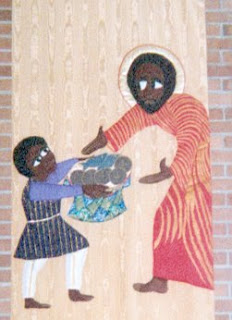
After a funeral this past Tuesday, I ate lunch with one of the many ministers in attendance. This man has served a large, urban congregation for decades. We were talking shop. I asked him if he’s heard more pastors preaching a so-called Gospel of prosperity, over Jesus’ Gospel of the kingdom of God.
As our conversation continued, we became more passionate. We were sure that we preach Jesus, crucified and raised. We congratulated ourselves for keeping a cross in our worship spaces. We applauded each other for keeping national and denominational flags out of them. We consoled each other for feeling inept at reaching out to 20 and 30 something generations.
Just as I began wondering if we were sounding a little too righteous, my companion shared this. He said a local casino sent letters to all the pastors, offering each a free overnight stay, as well as $1,000 in chips. Then he said, “I will never be seen in casino.”
It wasn’t until much later in the day when I asked myself, “Did he mean he’ll never go and gamble, or did he mean he won’t go gamble at a site where someone who knows him might see him?” Was his statement sincere; “I won’t be seen because I’ll never be in one”? Or is he a hypocrite? I’ll never know; neither will you.
Sometimes, when a story’s ending doesn’t satisfy, we become irritated. Other times, a story’s disappointing ending causes us to discard the story all together. Then, there are those story’s whose inadequate end captures our imaginations as we mull over a variety of preferred, or more desirable, endings.
Jesus’ open, seemingly unfinished ending to the parable we call the prodigal son still catches most hearers up short (See Luke 15:1-3; 11b-32). That often results in some over analysis of both the story’s beginning, and / or a solitary focus on the story’s three main movements, the:
• younger son’s awakening
• watching father’s grace-filled, unconditional embrace
• charged language used by the older brother to his father.
Following an insight I’ve borrowed from Sharon H. Ringe, a Professor of New Testament at Wesley Theological Seminary in Washington, D. C., let’s take a different tack. First, though, it should be noted that scholars who are women frequently offer biblical interpretations which are out of the main – if main is taken as the male-dominated historical-critical methodology that grew out of the German Enlightenment. This is a true blessing to the church.
As an aside, here’s a quick primer on the distinction between male and female scholarship. In her pioneering research, Carol Gilligan contrasted the moral development of females with that of males in her work, In a Different Voice. She observed that boys’ games, e.g., sand-lot baseball, purposed around competition and rule-keeping. Girls’ games, on the other hand, e.g., jacks, seemed to purpose around a way to “pass time” as these females focused on broadening and deepening their emotional relationship. (Sure hope I don’t sound like a candidate for the presidency of Harvard, here!)
Dr. Ringe’s insight – that is the only piece with which I’m familiar – is in re-naming this parable The Parable of the Beloved Brothers. My interpretation of Luke’s parable is based, principally, on that title. Errors in interpretation / understanding, then, are solely my own, and ought not to reflect on Dr. Ringe.
Male dominated scholarship frames the parable of the prodigal son within a win / lose dynamic. The plot line’s thrust is competitive. The story’s conclusion lends itself either to victory / surrender, or to a mano a mano standoff.
Hearing the story as the parable of the beloved brothers gives us a chance to redirect our own meaning-making efforts. At one level, nothing changes. The characters are the same. Their actions are constant and consistent. The conclusion is still abrupt, and, to some, less than satisfying.
At another level, Dr. Ringe’s re-naming changes everything. The sudden, nasty request by the younger son that his father “drops dead” and hand over the inheritance alludes to a prior and perhaps long-standing family strain. The boy’s dissolute living may be his effort to “buy” the affiliation and belonging he had at home, rather than a groin-oriented plot to sow his wild oats. His planned confession may be less belly-focused narcissism and more a parley with himself to restore relationship with his family.
The father’s reaction, “filled with compassion” draws us to realize that the Hebrew equivalent of this word is womb. The father re-wombs the younger son and so has no need to hear the confession, which, then, remains unspoken.
In the parable of the beloved brothers, the feast has all the trappings of a wedding feast, an experience wherein the prior stories of distinct families are entwined in the present and fashion momentum toward a new future. It’s only in the parable of the prodigal son that the feast resembles a “victory lap.”
Onto the scene arrives the elder brother. He’s carrying not only the fatigue of today’s burden, but the long-held resentment of days gone by. His distancing language, “this son of yours,” reveals all the angry baggage of someone who’s played by the rules, but lost the game to a cheater.
For his part, the wombing father speaks the same words, using the same endearing tone which brought new life to his “dead” younger son.
The story’s conclusion poses two theological challenges. That is, two opportunities for us to change our minds about who God is and how God works.
First, the parable of the beloved brothers forces us to admit that our understanding of sin, grace, repentance and forgiveness are really quite shallow.
We like to construct a world that says: God likes to forgive. I like to sin. Therefore, borrowing from Louis Armstrong, we sin, what a wonderful world!
We tend to see sin as rule-breaking, law-breaking. In Greek, the word is “missing the mark.” Not hitting the bull’s eye means something else gets hit. The result of sin is deep and broad breaches. The affects of sin are anguish, brokenness, grief and pain – within our self, among our relationships, and amidst the Godhead.
In our equation, grace becomes what an offender is owed, by a gracious God. Repentance, then, is a quick, “I’m sorry.”
Forgiveness is a reward for an apology, usually doled out with no small measure of wariness. Our forgiveness is often cunningly disguised revenge. It’s frequently dispensed with a shrug that sweeps an offense under the rug of political correctness, or tolerance.
The second challenge / opportunity the parable of the beloved brothers poses, besides exposing the cyclical nature of our life under the first challenge, is to say that with this God, in this God’s Christ, the past does not need to prescribe the future.
Sin is no longer about laws, shoulds / shouldn’ts, it’s about our being who God wants us to be, or who we choose to be when we determine to take God’s place.
Grace is about God’s own yearning and yawning when God experiences our absence. Grace is the movement of God to reconnect with us, before we apologize.
Repentance is our coming-around-to, our turning-toward, our changing from “me is god,” to God is God, as a result of God graceful wombing.
Forgiveness, then, is not about no longer remembering. Forgiveness – since it’s offered before apology or repentance - becomes, we’ll (God and us) move into a new future where we re-member, as in reconnect, reattach.
The “unsatisfying” ending we experience is the only plausible ending for the parable of the beloved brothers. It’s the only conclusion that reveals the open-endedness of the Kingdom of God.
This ending is the only accurate representation of the life-giving, freedom-bringing, home-making God (Walter Bureggemann) that accounts for the compassionate / wombing God that Jesus knew. This ending is the only comprehensive portrayal of the costly grace that’s faithful to the breaking-open, pouring-out Jesus’ sacrifice for us.
This ending is the end of my story, your story, and everyone’s story – beyond our wildest dreams. But you already knew that’s how it ends.
Showing posts with label repentance. Show all posts
Showing posts with label repentance. Show all posts
Tuesday, March 20, 2007

Sunday, February 25, 2007
A Fetching Time
She hadn't meant to cause any harm. She especially hadn't meant to upset the villagers, to bring shame to her family, to put distance between herself and her husband, or to bring on so many sleepless nights.
It wasn't supposed to become a distraction, or such an attraction. It was just a tale, not even a whole story. That's why she'd filled in a few of the blanks, stitched a few details into gaps in the time line. Now it had gathered its own steam, taken on a life of its own, and it was smothering her. What to do?
What to make of the looks people gave her as they drew back into narrow doorways to let her pass by as she walked in the square. They felt like daggers as her friends' eyes darted past her. Wanting, it seemed, to probe her face, but not wanting their eyes to meet hers. What to do?
It was only Tuesday. She couldn't wait for the priest to open the confessional on Saturday afternoon. She might even be dead by then. Oh, the weight of it all; pressing down on her neck, shoulders and back. It made her legs wobble. Her color was bad, probably due to taking too many short breaths. She couldn’t breathe right. It seemed that her heart had swelled in her chest, squeezing the places her lungs were supposed to occupy. Her heart was so heavy. It pushed down on her stomach. Now she could barely eat the crusts of bread she soaked in warm water mixed with olive oil and vinegar, just a dash of vinegar. Everything tasted so bitter lately. Even sweet bread had a sour taste. What to do?
She'd simply have to press Padre Giuseppe to hear her confession today, after the noon-time Angelus. He'd understand. He was a good priest.
It's a story my grandmother told about an old woman living in Italy who gossiped about a neighbor. Realizing her sin she confessed to the priest. The confessor said, "For your penance, take a down pillow up into the bell tower, cut it open and shake the feathers onto the town square, then go gather the feathers and return them to the pillow. When you've fetched all the feathers, now scattered as far as your gossip has flown, your sin will be forgiven."
Our religion tells us that this is a story about penance. It's really a story about repentance. Literally, the word repent means to drive back; to drive back to a point in time before you held that thought or did that deed, and then not take up the thought or commit the deed. To repent is to feel such remorse about a past thought or deed, that you change your mind and your ways.
Sometimes we use our religious language so casually and thoughtlessly that it loses its power to give shape and meaning to our lives. Lent is full of religious language: pray; fast; give alms; repent. But if these words don't gather the energies of our hearts and minds, if they roll off our tongues like so many tales of days gone by, then they lose the power of transforming grace deep-seated in God's holy Word.
Forty days. Enough time to recall that religious language, the Word of God, means to shape all our days, not just our Sundays. Forty days. Time enough to remember that the death and resurrection of Jesus is for our everyday. Lent. Time to experience a continuing death of the old and familiar. Time to be reborn again into new hope, new trust, and new love. Lent. Time to say what you mean and to mean what you say. Lent. Time to fetch the feathers.
Tuesday, November 14, 2006
God's Anger Management Plan
My seminary professors suggested I find a model, using a character from the Bible, to give form and shape to my Christian identity. It's a good idea. Through prayer; by inventorying your talents; discovering your passions; and in conversation with friends; it's possible for all of us to find a biblical character or role to imitate. You might be drawn to:
• Jesus the teacher or Jesus the healer
• Esther, the real power behind the throne
• Mary, the meditative pray-er
• Zaccheus, the repentant crook
• Joseph, (either Genesis or Luke) the crisis manager
• Martha, the never say no over-achiever.
The strategy is a sound way to experience what we call sanctification - a deepening relationship with God. As Saint Paul says, we can experience progress and joy in faith because we live lives worthy of the Gospel.
Growing up in the sixties, seeing racial injustice and the horrors of war in Viet Nam, I found a model that works for me. I've always felt drawn to the motives and actions of biblical prophets. Their motivation was to remind people of: God's faithfulness to us; God's love and care for us; God's desire for a just future for all people; and, God's reign of shalom over the universe.
The prophets seem to have achieved this by: comforting the disturbed and disturbing the comfortable. There's also the idea that the roles Jesus used to declare and make present his vision of the reign of God was to act as priest, prophet and king. Some people recognize that all those baptized into the mission and ministry of Jesus must come to understand our identity and our roles that way.
Not only does the prophetic model suit my talents and my temperament, a way of seeing and acting that I'm drawn to and good at, it also seems to be a role that others call on me to perform. In most jobs, I've been a builder and a fixer. As a pastor I must analyze how our community of faith is organized; what's really getting done as opposed to what's supposed to be getting done. It's made me learn to pay attention to how each of us is functioning. Are we thriving as persons? Do we feel honored and cherished? As a group are we cooperating, supporting one another, challenging each other? Is this a congregation in which it's OK to take risks? If a person fails or a project misfires can we move on? Or do we sow doubt; practice distrust; count things against one another; carry tales; hold grudges? What holds us together? Are we operating from a clear consensus about strategies to achieve God's mission, or do we promote personal anxiety and corporate discontent when the compromises we reach create winners and losers?
Well, no matter how skilled and clever we are inside of our ministry model, we are, as Luther frequently points out, simul justus et peccatur, at once saints and sinners. And because of that, achieving the balance between the role shaping us, and our shaping the role can be tough.
That's a lesson we can't be sure Jonah ever learned (read especially 3:10-4:11). And we can use the fact that we're not sure he learned it to assess just how well we've learned it. Maybe I'm not the only one who could use a refresher course.
Prophets are often described as angry. We see that in our own day when advocates for justice demand that the United States send troops to stop ethnic cleansing. They use blistering words to goad our leaders out of paralysis by analysis and into decisive action. There is such a thing as righteous indignation and holy anger.
In a similar way the anger of Jeremiah or Amos was rooted in a love for God and love for the very people who were the object of their wrath. Their aim wasn't personal vindication but the vindication of God's truth and justice, by Israel's conversion to the same sort of faithfulness God had extended to the chosen people. If the prophets saw more clearly than other folks that Israel's real choice was life or death, their hope and prayer was that the people would choose life. And so their words -sometimes spoken angrily - at other times in heartbroken sobs - were directed to that end. Their witness wasn't motivated by anger, but by love.
But then there is a prophet like Jonah. He found his mission so unpleasant that when the word of God came to him to bear witness against Nineveh, he fled in the other direction. Now we all remember the unusual taxi ride by which Jonah got heaved up on the beach, but we don't always remember the lone sermon he delivered to the Ninevites. In all the woe sayings; the oracles; the judgments; we hear from the prophets, Jonah's stands as the most lame. It goes like this, "Forty days more and Nineveh shall be overthrown."
Amos called Israel's women "cows of Babylon." Ezekiel called Israel "unfaithful harlots." Hosea called Israel a "temple prostitute." So Jonah's words lack the passion, not to mention the sincerity, necessary to get a whole country to change course. But Jonah's words have such an impact that the king and the nobles order even the animals to repent with fasting. So effective is Jonah's sermon that the people are thoroughly converted and receive God's forgiveness.
Is Jonah relieved? Uh-uhh. He's furious. And here we see the true source of Jonah's anger. Jonah is angry over God's mercy. That's why he got into the boat in the first place. He was afraid that his prophecy might work. He didn't want anything to do with a God who would let Nineveh escape what Jonah had determined was its just desserts. What kind of God is that? You can't predict what that kind o’ God is gonna do. You can't control a God like that. So God responds to Jonah's rage with a compassionate, almost parental question: "Do you do well to be angry?"
Like a two-year old child, Jonah storms off, putting distance between himself and God, once again. He goes outside the city, and builds an isolation booth, an outhouse, still hoping to see God's wrath blaze against Nineveh. But the only thing blazing is the scorching wind - in Hebrew - ruach. The same word used to describe God's breathing life, light and hope into every isolating booth, especially the one-person-tent we know as the unloving, unforgiving human heart - an outhouse of our own making.
Now we're not used to it, preachers don't help us see this often. But God does have a sense of humor. God's response to Jonah's tantrum, which has him all tangled up in knots; - has his bowels in an uproar - is to raise up a castor oil plant, at the threshold of this outhouse! It's as if God says,
"Get over it Jonah. Take a physic! This, too, shall pass!"
Like everything else, Jonah gets it wrong. He thinks the plant has more to do with his outsides than his insides. The only thing Jonah let's pass is another chance to see God's mercy and love. When the plant dies Jonah spins out of control. And God asks, "Do you do well to be angry for the plant?" Jonah replies on cue, "Angry enough to die." Jonah still can't stomach a merciful God. This is one angry prophet!
God tries to give Jonah some perspective. "OK, if you're willing to die for a castor oil plant, shouldn't I care for a whole city?" Do you see the contrast between Jonah's impotent, death-dealing rage and God's compassion - God's wombing the men, women and children back into life-giving relationship? God says, "Should I not pity Nineveh, a great city, in which there are more than 120,000 persons who don't know there right hand from their left, and also much cattle?"
What's going on here isn't a story about Nineveh at all. It's a story of Jonah's own call to conversion. It's not enough to be an agent of God's anger. True prophets are called to be agents of God's love.
"Do you do well to be angry?" It's not whether Jonah's anger is justified. We all have cause to be angry sometimes, but does our anger do well? Does anger do anything but feed our sense of being absolutely right and our enemies absolutely wrong? Feeling that way, don't we get a kind of high by going off into some fantasy-land where we see ourselves heroically showing the whole world just how right we are? But do fantasies bring conversion, prompt reconciliation, or add an ounce of justice to the world?
We would rather vent our anger than convert enemies into friends. Often our words and actions suggest that the very last thing we want is for our enemies to admit they're wrong and change their ways. Convinced that we are agents of God's justice, we eagerly deliver a word of judgment. We're quick to pronounce the death sentence. We're not so eager to deliver the merciful words of clemency and relationship.
The story of Jonah's call to conversion reminds us of the many ways we prefer our ways over God's ways. We:
• flee to the east when God would have us go west
• run outside the city gates
• build us a one-person-tent to isolate our angry heart.
Jonah's call to conversion reminds us it's not enough to be an agent of God's anger. Anger may be necessary to point out a problem, but anger is never sufficient to birth a solution. There are many causes for anger in this world. But God's mercy isn't one of them.
What are we afraid of? What part of God's care for us and for this world do we think we have to predict? Do we think we should control God's care and love and mercy? What fears do we have of God that make us angry with God?
That's what the story of Jonah is all about. Do we do well to be angry? It doesn't matter. The good news is that, angry as we are, God's mercy extends to us as well:
• that might mean gettin' thrown overboard
• that might feel like bein' swallowed up by a monster
• it could come to gettin' coughed up onto a beach
• we may even look washed up and rung out.
It doesn't matter. This God is always for us. This God creates us in love, redeems us in Christ and sends the Spirit to call and gather us, alone and together, to join in telling others that same, simple Good News: "Look, I got myself all scared and angry and bound up, then this God sent me a castor oil plant and I got over it. God will help you get over it too!"
Subscribe to:
Posts (Atom)


 Posts